
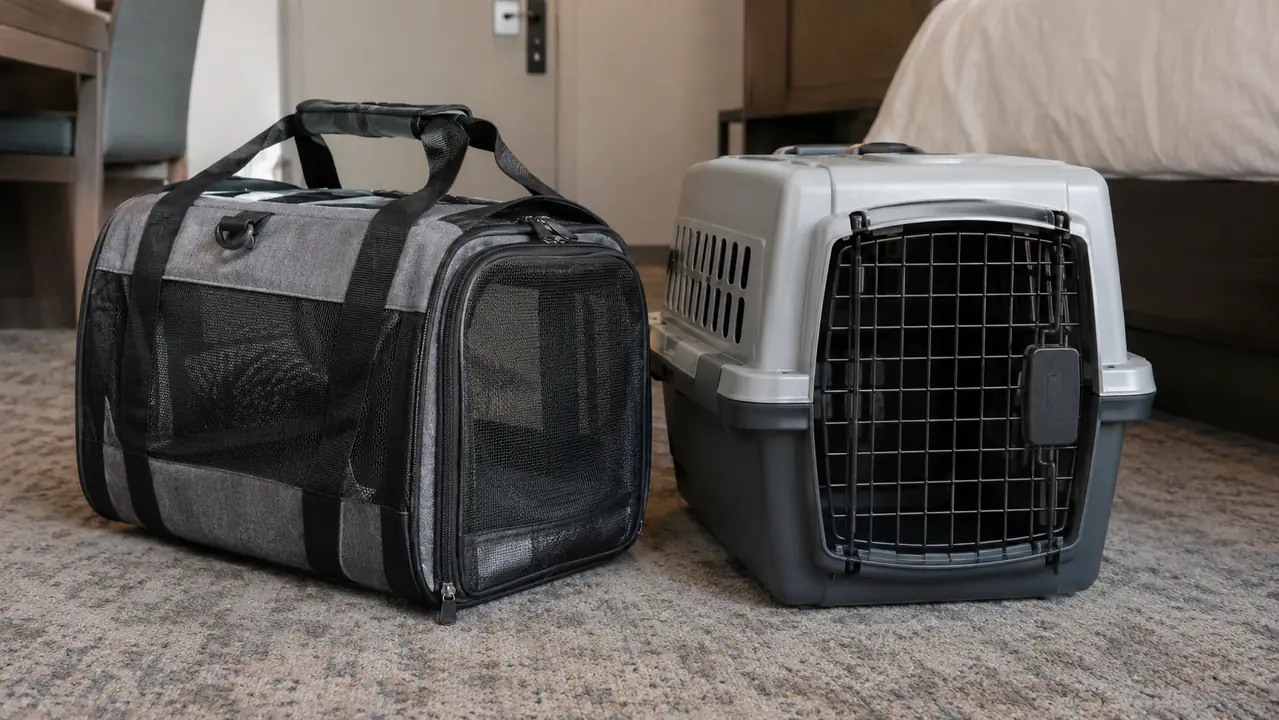
When my sister Joan started joining us for the longer road trips, she brought along her 10-pound Shih Tzu, Pip, and asked the question every small-dog owner eventually asks: should I get a Sherpa soft carrier or a hard-sided travel crate? Joan lives in Charlotte, so she and Pip meet us at the start of each trip, which means we have the whole drive to talk gear through. I had opinions already, but I wanted to test them the slow way, over real trips, before I told her what to buy.
So I borrowed both. A Sherpa Original Deluxe soft carrier in medium, the kind you see under airplane seats and in every motel lobby, and a hard-sided plastic travel crate about the same size, roughly the same footprint but four times the weight. Over three months I used them on a long weekend in the Blue Ridge in May, a week of lake cabins in Tennessee in June, and a stretch of pet-friendly motels along the Carolina coast in September. I kept a spiral notebook in the glove box and wrote down what worked after every leg: how long it took to load the car, how Pip settled, what Ron grumbled about. This is what I learned.
The short answer: For almost every small-dog travel situation, the Sherpa soft carrier wins. The hard crate wins exactly one job: giving an anxious dog a dark, den-like cave in a strange room.
The soft carrier that rode along on every single trip
After three months of testing, the Sherpa Original Deluxe is the carrier I keep reaching for. It folds flat, fits under a seat, and Pip settles into it like it is her own little den.
Amazon Check Today's Price on Amazon →| Sherpa Soft Carrier | Hard-Sided Travel Crate | |
|---|---|---|
| Weight | About 2 pounds, easy to carry one-handed | Usually 8 to 12 pounds before the dog is in it |
| Packing | Folds flat into a tote or suitcase | Bulky, awkward in a packed Subaru |
| In the car | Sits on the seat, buckled in, dog can see out | Sits on the seat or cargo area, dog sees walls |
| In a strange motel room | Familiar fabric den, easy to keep close to the bed | Dark, crate-like cave, very calming for anxious dogs |
| Cleaning | Machine-washable liner, spot-clean the shell | Wipe down the whole thing with a hose or cloth |
| Chew resistance | Fabric, not chew-proof for a determined dog | Hard plastic, tougher against scratching and chewing |
| Airline use | Airline-approved, fits under most seats | Must match airline dimensions, often gate-checked |
| Best for | Small dogs under 18 pounds who travel often | Small dogs who need a dark, secure cave to settle |
Where the Sherpa Soft Carrier Wins
The first thing you notice about the Sherpa is how little it asks of you. It weighs about two pounds, which matters when you are also carrying a tote bag, a coffee, and a leash. I weighed it on the bathroom scale the morning we left for the Blue Ridge: two pounds, three ounces with the liner in. The hard crate, for comparison, weighed nine pounds empty and did not fit on the scale without me holding it, so I gave up and just called it heavy. The Sherpa folds flat, so on the drive home it tucks into the back of the Subaru without eating the whole cargo area. And it has a carrying handle plus a shoulder strap, so when Joan and Pip walked from the motel to the diner, the carrier hung off Joan's shoulder and Pip rode along like it was nothing. Ron timed us one morning: from the motel room door to the car door, Joan with the Sherpa on her shoulder and Pip's leash in her hand, took forty seconds. The day we tried the same walk with the hard crate, it took us four minutes and Ron carried the crate while Joan carried Pip, because you cannot do both with two hands full.
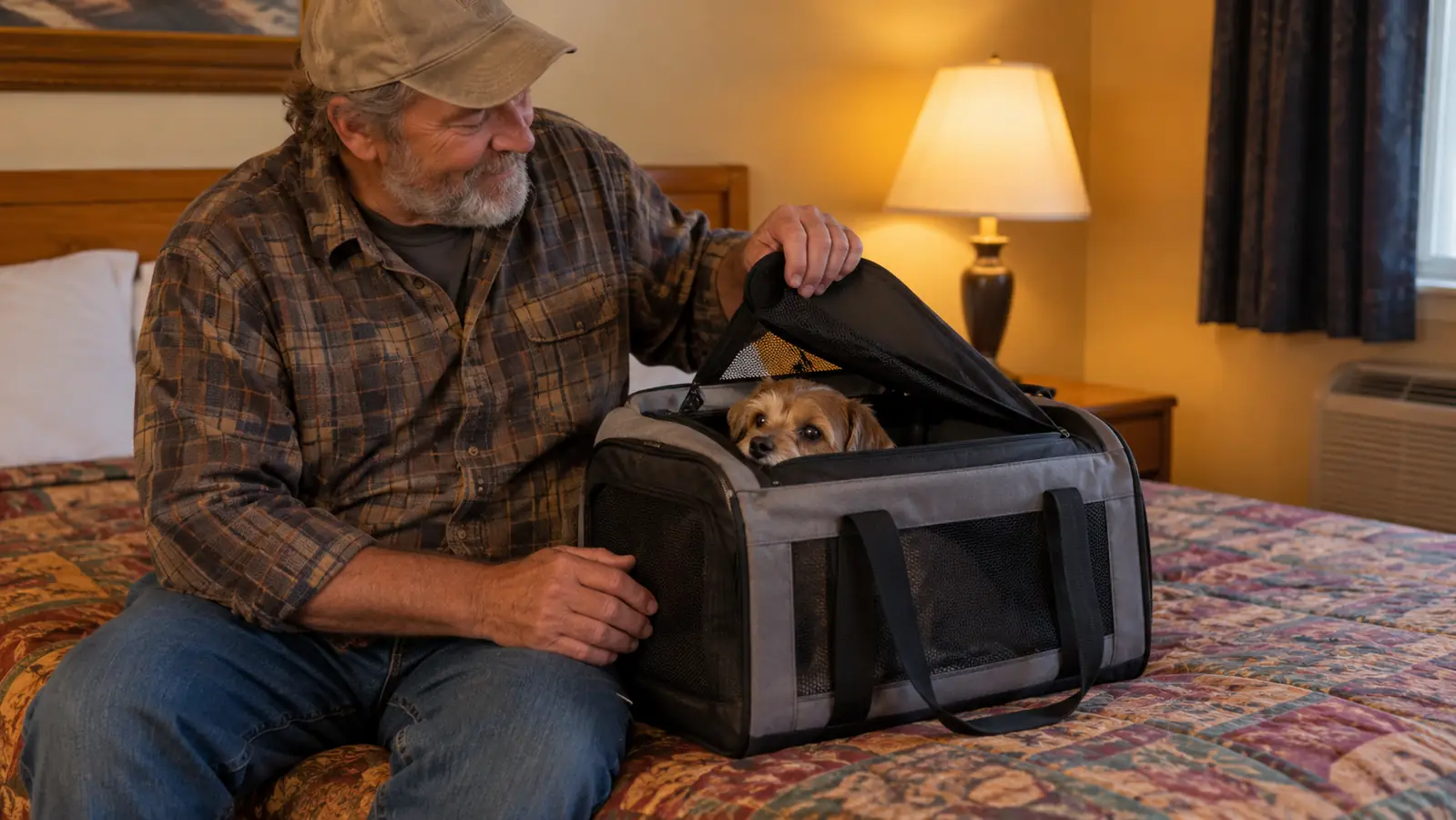
The bigger win is how Pip behaves in it. The Sherpa has a soft, flexible structure and a liner she could nest into. On the car seat, buckled in with the seat belt through the back handle, she could see out the window, which kept her calm on the long stretches. The first time we drove the Blue Ridge Parkway, she watched the overlooks go by for a solid hour before she curled up, which is not something she does in a crate with walls on every side. In the motel room, she climbed in on her own and went to sleep. Joan stopped calling it a carrier and started calling it Pip's bedroom. By the end of the first trip, Joan did not even have to tell her to get in. Pip would see the Sherpa come out of the car and trot over to it.
I want to be specific about the packing difference, because it is the one that decides whether a carrier actually comes on the trip. The Sherpa folds down to roughly the size of a thick magazine, maybe nine inches by twelve by four. I slid it between the suitcase and the cooler in the back of the Outback and forgot it was there. The hard crate, by contrast, sat in the cargo area for the entire drive, and when we stopped for lunch I had to move it to reach the spare tire kit. We keep a small canvas bag with the emergency kit, the dog bowls, and a rain jacket, and it fits in the space the Sherpa takes up when it is folded. On the second day of the Tennessee trip, Ron asked if the crate could live in the motel room instead of the car. That is the whole argument in one sentence.
There is also the matter of the shoulder strap, which I did not expect to care about. The Sherpa's strap is long enough to wear crossbody, which leaves both hands free for the motel key, the coffee, and the leash. Joan used it every single time we walked from the room to the car, and by the third day she had stopped adjusting it, which is how you know a strap is right. The hard crate has no strap at all. You carry it with two hands, in front of you, like a very awkward box. On the morning we checked out of the lake cabin, Joan carried Pip in the Sherpa and Ron carried the hard crate down the stairs. Ron got to the car first, and he was not carrying a dog. I do not think I need to tell you who volunteered for the stairs the next morning.
Where the Hard-Sided Crate Wins
I will not pretend the hard crate has no place. It does, and it is a specific one. The hard-sided crate is a cave. It blocks light, muffles sound, and gives an anxious dog four solid walls to press against. I understand this better after the Wilmington night than I did before it. On the one night Pip was overtired and whiny, we set up the hard crate next to the bed and she was asleep in ten minutes. The Sherpa never did that for her. The soft carrier is cozy, but cozy is not the same as enclosed. When a small dog is past tired and the room is strange, the difference between a fabric nest and a solid box is the difference between a blanket and a bedroom. Pip pressed her back against the plastic wall the way she presses against the back of the couch at home, and that pressure is what settled her. I have seen her do the same thing in her own crate in Joan's living room, so I should not have been surprised, but I was.
The hard crate is also tougher. A determined dog can work at a fabric corner, and if yours is a chewer, the plastic walls win. Pip is not a chewer, so this mattered less for us than it might for you, but I would not trust the Sherpa with a dog who has ever eaten a bed. The tradeoff is that you feel every bit of the hard crate. At eight to twelve pounds, it is heavy, it does not fold, and it takes up most of the cargo area. For a weekend trip it was fine. For three months on the road, it would have driven me crazy. We loaded the car for the Tennessee trip on a Sunday morning, and the crate went in last because it would not fit anywhere else. It took up the space where we usually put the camp chairs, so the chairs ended up wedged between the cooler and the back door, and every time we stopped, Ron had to unload the chairs to get to the crate.
Let me tell you about the night that made me understand the hard crate. We were at a motel outside Wilmington, the kind with thin walls and a noisy ice machine down the hall. Pip had been in the car for six hours and she was past tired, pacing the room, whining at nothing. Joan tried the Sherpa first. Pip climbed in, climbed out, circled the room, climbed back in. Nothing stuck. Joan sat on the edge of the bed and looked at me the way you look at someone when you are both too tired to decide anything. Then Ron set up the hard crate with the blanket we had brought from home, the one Pip sleeps on in Joan's living room, and Pip walked in, turned around twice, and lay down with her chin on the blanket. She was out in under ten minutes. The Sherpa is a wonderful travel companion, but it is not a blackout curtain. The hard crate is.
The cleaning difference is real too, though it cuts both ways. The hard crate wipes down in about two minutes with a damp cloth, and after a rainy day at the beach I was grateful for that. The Sherpa's liner comes out and goes in the washing machine, which is better for the weekly grime, but the shell itself needs spot cleaning and it does not dry instantly. I learned that the hard way on the coast, when I washed the liner after a muddy walk and had to lay it over the back of a chair with the room heater on. Neither is hard to maintain. They just ask for different kinds of effort.
The everyday carrier, through and through
The Sherpa Original Deluxe is the carrier that came on all three trips and the one Joan reaches for without thinking. It will not replace a dark crate for an anxious dog, but it will earn its spot on every other day of the year.
Amazon Check Today's Price on Amazon →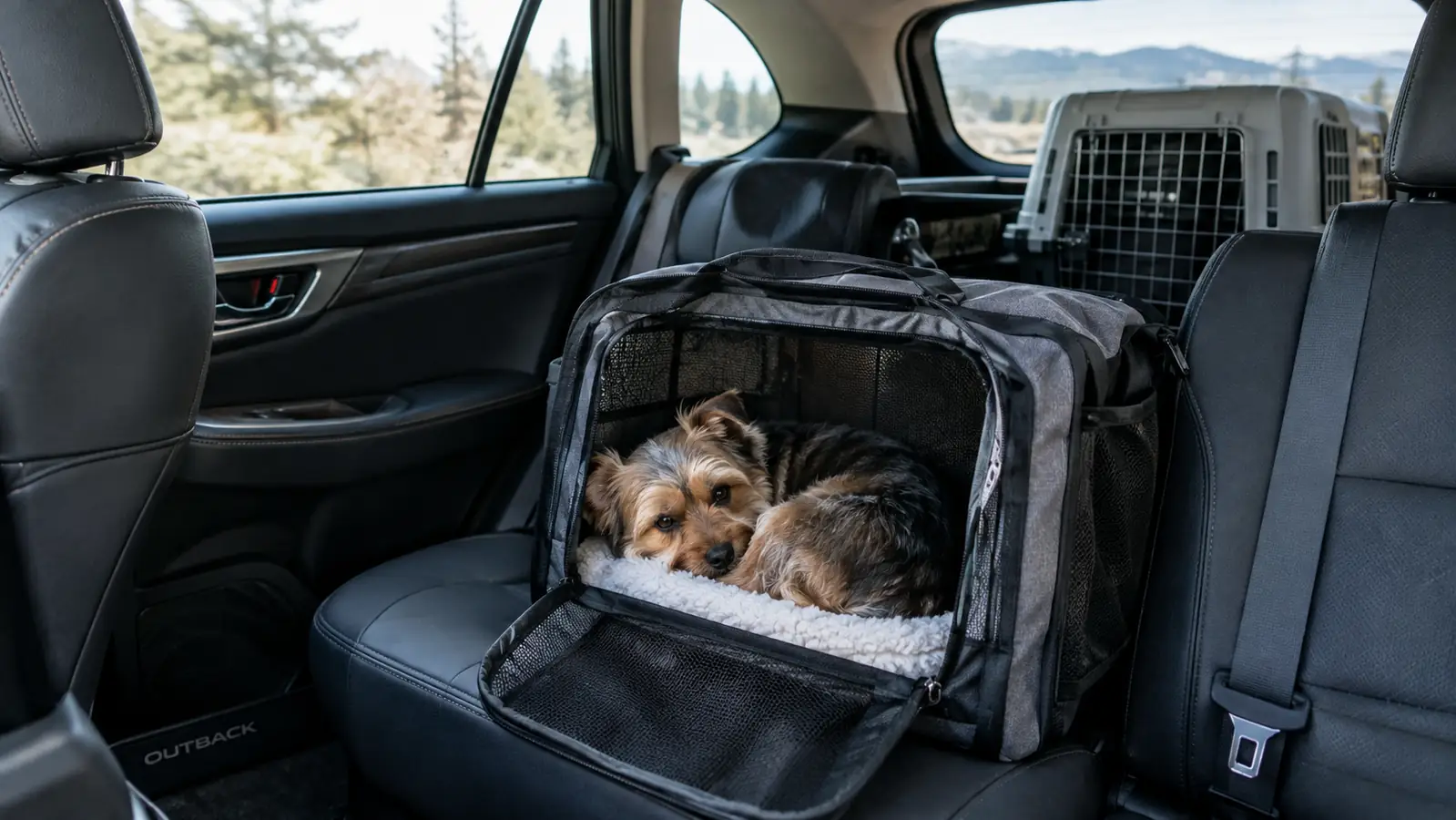
Who Should Buy Which
Buy the Sherpa soft carrier if your dog is under about 18 pounds and travels with you often. Buy it if you fly, even occasionally, because it is airline-approved and fits under most seats. Buy it if you want something you will actually take with you instead of leaving in the garage because it is a hassle. That last one is the test I trust most. The gear that makes it into the car on a Tuesday afternoon when you are running late is the gear that matters, and the Sherpa is the one Joan reached for every single time.
Buy the hard-sided crate if your dog panics in new places and needs a dark, enclosed space to feel safe. Buy it if you have a chewer or a digger. Buy it if your trips are mostly by car and you have room for a bulky second item. And if you can afford both, that is honestly the best answer: the hard crate stays in the motel room while the Sherpa comes along for everything else. That is the setup we have settled into after three months, and it is the one I would give Joan if she asked me again tomorrow.
One more note on the both answer, because it is the one I actually gave Joan. The Sherpa is the everyday carrier, the one that lives in the car and comes into the diner and rides under the seat on the rare flight. The hard crate is the specialist, the one you pack when you know the motel will be noisy or the dog will be overtired. If you only buy one, buy the Sherpa. If you travel enough to own two, you will use both, and you will not feel silly about it. Joan bought the Sherpa first, and she has not once wished she had bought the crate instead. That is the simplest way I know to sum up this whole comparison.
The Sherpa weighs about two pounds and folds flat. The hard crate weighs ten and does not fold. After three months, I knew which one I would pack.
The one that earned its spot in the Subaru
The Sherpa Original Deluxe has now done three road trips, two motel stays, and one very long drive down the coast. Pip sleeps in it. Joan packs it without thinking. That is the highest compliment a travel carrier can get.
Amazon Check Today's Price on Amazon →