
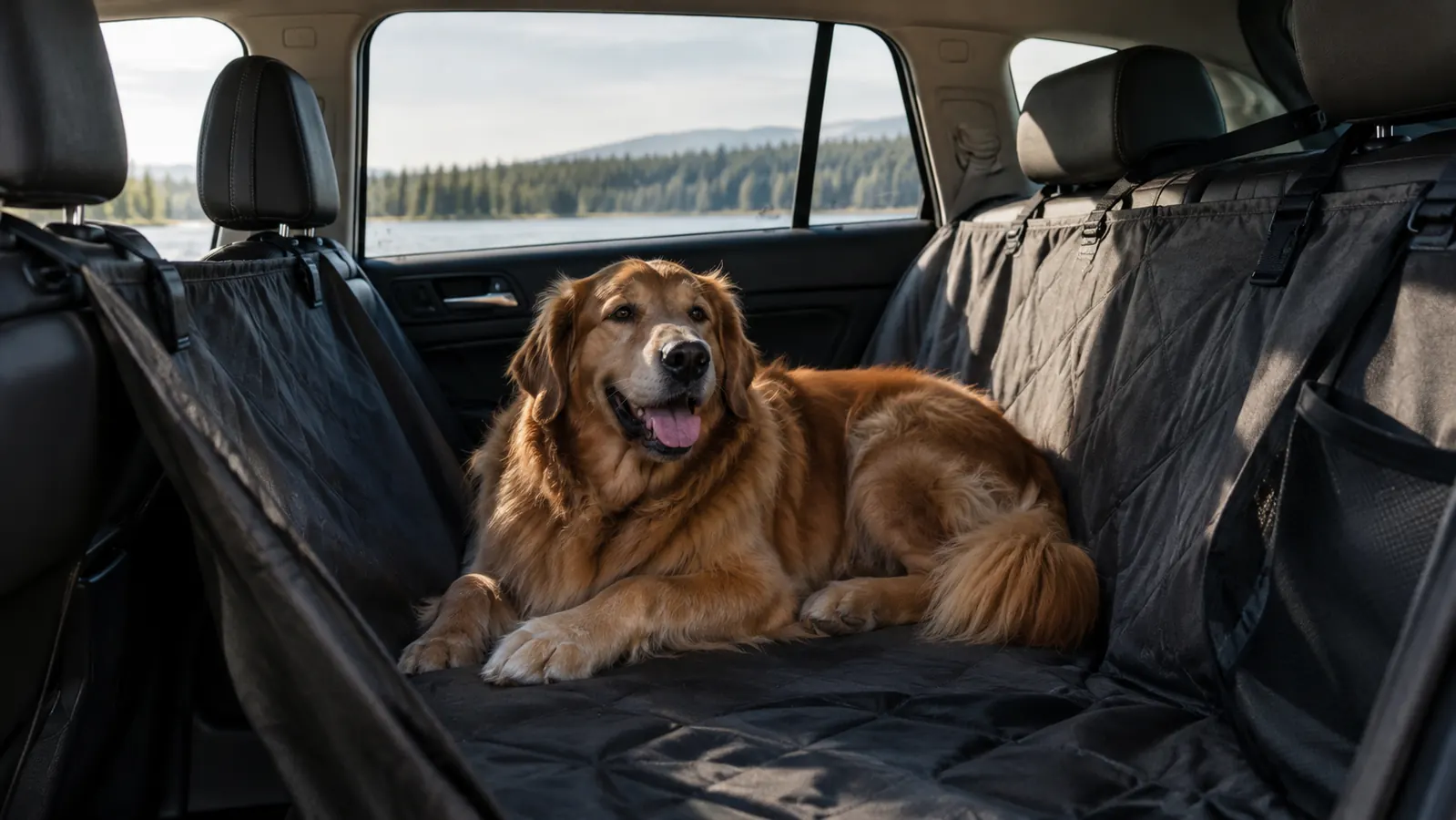
I bought our URPOWER seat cover before a trip to the Smokies, mostly because I was tired of brushing crushed crackers out of the seat creases with a toothbrush. That trip was nine months and about four thousand miles ago, and the cover has been through muddy lake days, a dog who refuses to settle until mile thirty, and one truly regrettable fast-food incident. Here is what actually holds up, what slips, and what the product page does not tell you. If you are reading reviews because you are tired of the same back-seat mess I was tired of, start here.
Maple is a 45-pound Australian Shepherd mix who loves the road once she finds her spot, but she spends the first half hour pacing the back seat, turning in circles, and testing everything within reach. We drive a Subaru Outback wagon and she rides in the back, so the back seat takes all of it: the pawing, the shedding, and the occasional surprise after a bumpy gravel road. This review is the honest version, the one you get after nine months of real trips, not after one careful afternoon of installation. I have no reason to pretend the cover is perfect. It is not. It is just better than anything else we have tried.
The Quick Verdict
A genuinely waterproof hammock cover that earned its place in our car over nine months and four thousand miles, as long as you know the edges are not a sealed barrier and the fit needs a little patience.
Amazon Check Today's Price →The Cover That Survived Four Thousand Miles With Us
If your back seat has seen its share of muddy paws and shedding, this is the URPOWER hammock cover Maple has ridden on for nine months. Check today's price on Amazon and see if it fits your car as well as it fits ours.
Amazon Check Today's Price on Amazon →How I've Used It
I do not review things from a weekend. I review them the slow way, the way you actually live with a product, and I think that matters for something like a seat cover. We take Maple on long trips, usually four months out of the year, and she rides in the back seat of the Outback for every mile. That means this URPOWER cover has seen interstate drives to Shenandoah, gravel roads to a lake cabin in western North Carolina, and plenty of wet mornings when the dog came back from a hike carrying half the trail with her.
The first real test came on a rainy afternoon in April. We had stopped at a trailhead and the sky opened up about ten minutes into the walk. Maple came back soaked, happy, and completely covered in mud, and she jumped straight into the back seat before I could grab a towel. I stood there with the towel in my hand and watched the water bead up on the surface of the cover. The seat underneath stayed dry. That was the moment I stopped being careful with the cover and started actually using it. I still think about that moment every time someone asks me about the cover.
By month three I had stopped wiping it down after every trip, and honestly that is when the review really started. I wanted to know what this cover would look like after a year of real use without me babying it. The answer, at nine months, is that it looks lived-in but solid. The straps hold, the seams hold, and the waterproof layer still works. If a cover can survive that kind of use, it earns its place in the car. Ron noticed the difference too, and he is not a man who notices seat covers.
Our travel routine is the same almost every time. We load the Outback the night before, Maple watches from the driveway, and she knows the cover is going in before her. By the time we reach the interstate she has done her circles and found her spot in the deepest part of the hammock. The cover has made that routine easier, because I am not worrying about what she is doing to the seat while I am watching the road. That peace of mind is harder to measure than waterproofing, but it is real.
What the Waterproof Claim Really Means
The product name says 100% waterproof, and I will tell you exactly what that means in practice. The top layer is a coated fabric that water beads on instead of soaking in. When Maple came back from that rainy hike and jumped in before I could towel her off, the moisture sat on the surface and I wiped it away with a microfiber cloth. It did not wick through to the seat. That part is real, and it is the main reason I would buy this cover again. I tested it again on purpose after that, with a wet towel pressed against the fabric for an hour. The seat stayed dry.
But here is what nobody tells you. Waterproof does not mean spill-proof around the edges. The cover is a hammock, so it anchors at the headrests and along the seat, but the sides are only as high as the side flaps. If you pour a full water bottle onto the edge where the flap meets the door, some of it will find its way around the fabric. We learned this the way you learn most things, with a tipped cup, a very patient husband holding a towel, and a seat that needed wiping anyway.
For dog owners the practical question is usually about accidents and wet fur, not spilled drinks, and on that front the cover did its job completely. A nervous dog on a long trip sometimes has an off day. When it happened to Maple, the clean-up was a quick wipe and a wash, not a trip to the upholstery cleaner. That alone justified the purchase for us. I keep a folded towel on the seat anyway, because the towel catches the edge cases, but the cover does the real work.
I will also tell you why we chose a hammock style instead of a flat bench cover, because it matters. A flat cover protects the seat bottom and the backrest, but it leaves the gap between the seat and the footwell open, and that is exactly where a nervous dog wants to go. The hammock closes that gap. When Maple gets restless, she cannot work her way down into the footwell, and I cannot count how many times that has kept a bad moment from becoming a mess.
When Maple came back from a rainy hike and jumped in before I could towel her off, the water sat on the surface and wiped away. The seat underneath stayed dry.
The Part the Product Photos Skip
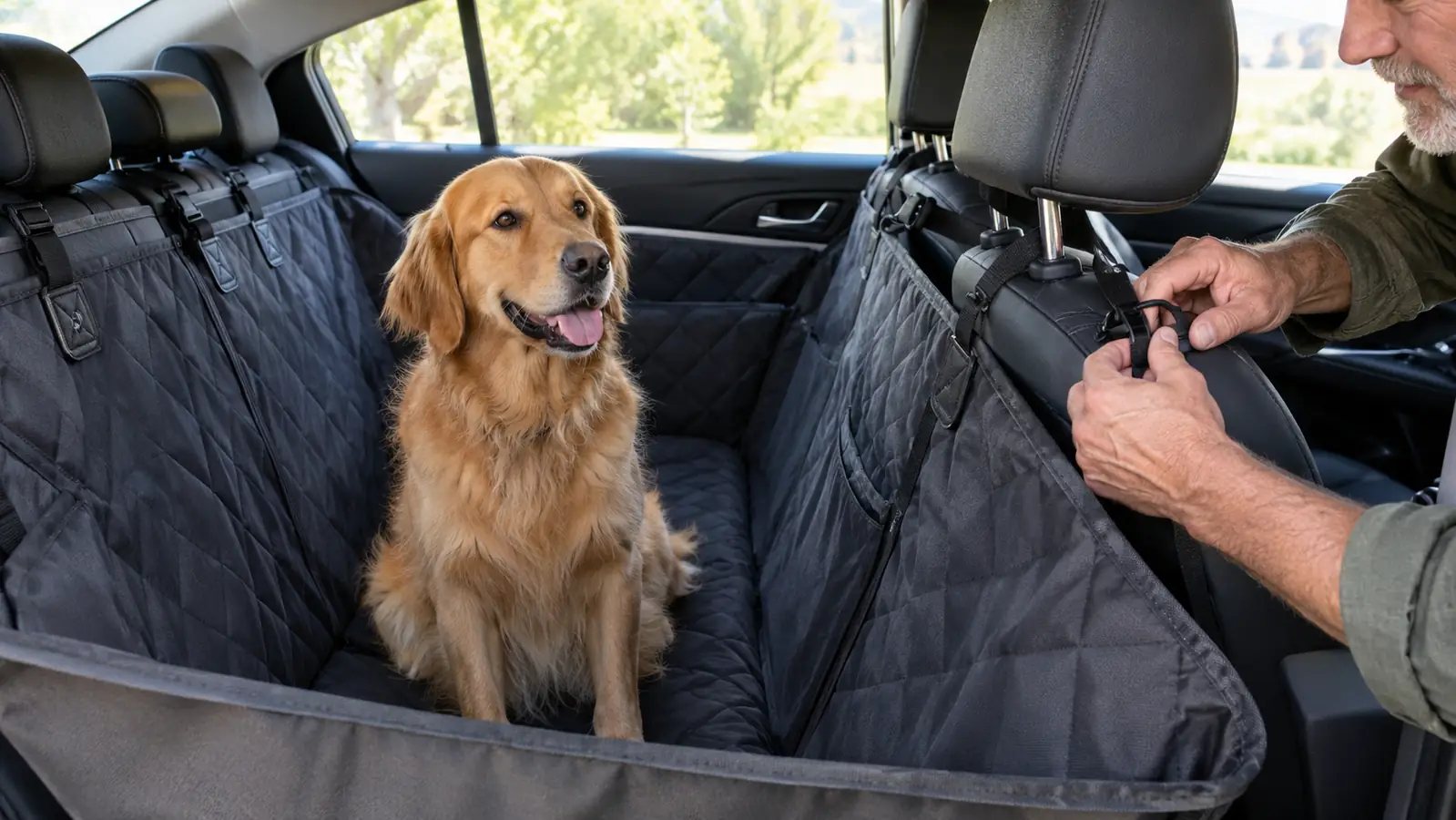
Installation looks easy in the photos, and it is, mostly. The hammock drapes over the front headrests and the back headrests, and two straps clip underneath. The whole thing took me about ten minutes the first time, which included reading the instructions twice. The second time took three. You clip the two front straps to the front headrests, pull the cover across the back seat, and clip the back straps to the rear headrests. The middle of the hammock drops into the footwell, which is what keeps the dog off the seat when you brake.
The honest part: the fit is good but not custom. The Outback has fairly tall headrests, and the straps were long enough, but the cover does shift over time. It is not a disaster and it does not slide off, but after a few trips I stopped expecting it to stay perfectly smooth, because it does not. The fabric creases where the seat folds, the flap near the door gets flipped up by the seat belt latch from time to time, and the middle sags a little more than the photos suggest. None of that affects what the cover does. It just means it looks lived-in, which after nine months I consider a feature.
The seat belt openings are the thing I would want to know before buying. The cover has slits for the buckles, and they lined up well on our Outback. If you drive something where the seat belts sit at an odd angle, check the fit before you commit. The side flaps also matter more than you expect. They are what keep a restless dog from hanging her head over the edge of the seat, and they are what catch the dirt that rolls off a wet paw. On our car they sit at the right height. On a taller SUV they might not.
Cleaning It: The Honest Version
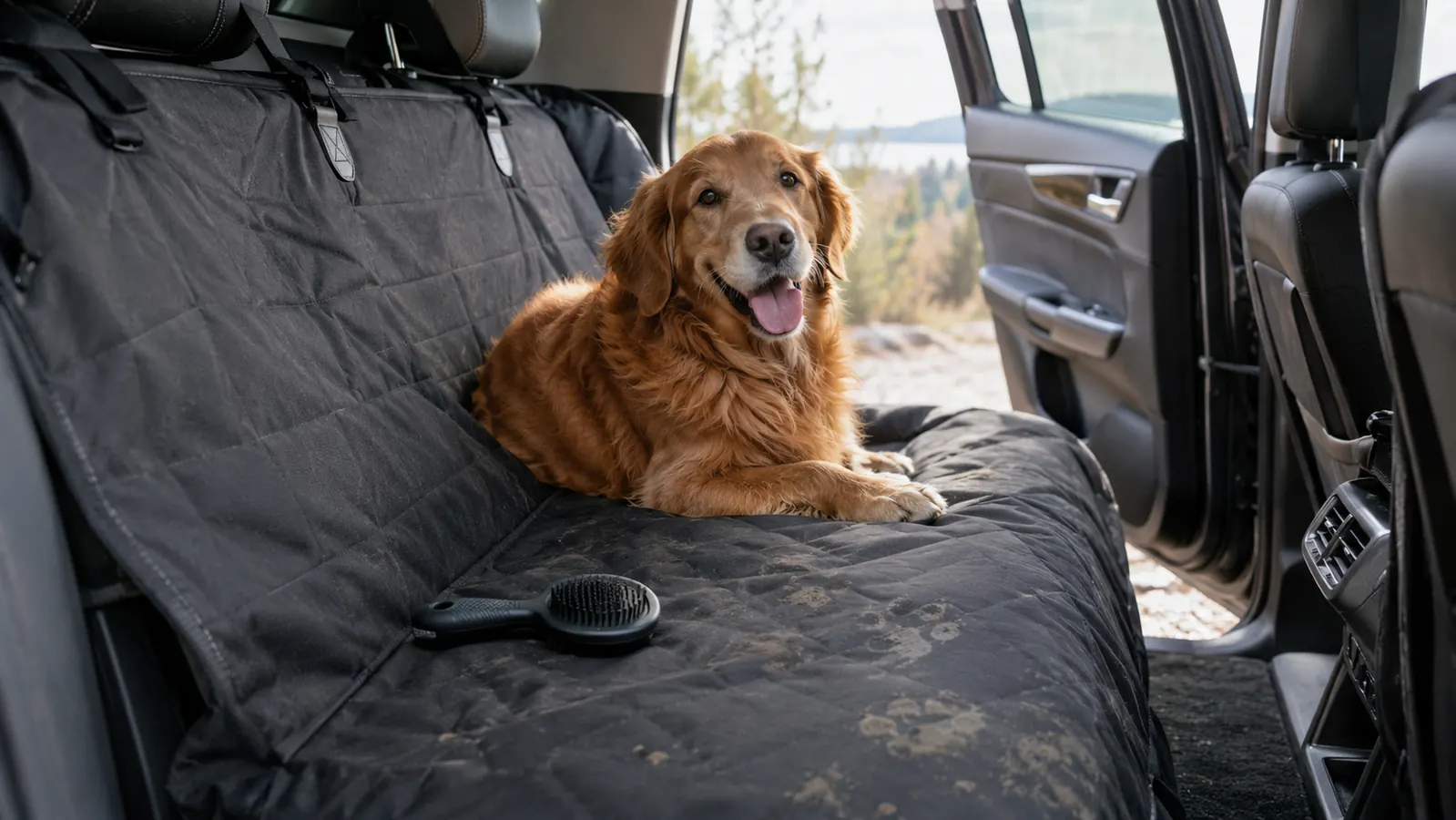
Here is the claim I was most skeptical about, because every cover says easy to clean and very few of them are. This one mostly is. Dog hair does not sink into the fabric. It sits on the surface, and a rubber brush pulls it off in about five minutes. Mud dries and brushes off. Wet paw prints wipe away with a damp cloth. I have washed the cover in the machine twice on a cold gentle cycle, and it came out fine both times, though I hung it to dry because the straps have elastic and I did not want to test their limits.
The part that surprised me is that the coating has not peeled or cracked after nine months of folding, stuffing, and machine washing. I expected it to fail by month six, and it has not. If you buy this cover, the cleaning routine you actually need is a rubber brush, a damp cloth, and an occasional cold wash. That is the whole routine, and it takes less time than I expected. The brush lives in the door pocket now, and the whole job takes about five minutes at the end of a trip.
One honest note about drying. The fabric is thick, and it takes a full day to air dry, sometimes longer in a humid mountain summer. Plan for that. Do not fold it away damp, because it will smell like wet dog and you will have to wash it again. We learned that one the slow way, on a rainy week at a cabin with a clothesline strung across the porch. It dried overnight and smelled fine, but I would rather have known to plan for it. If you have a dryer with a no-heat setting, that works too, but we have never risked the elastic in a hot dryer.
What Held Up Over the Miles
I checked the seams at month three and again at month nine. The stitching on the main panels is still tight. The coated fabric has no cracks. The elastic in the straps still snaps back. The only wear I can find is on the edges of the seat belt slits, where the buckle rubs, and that is cosmetic, not structural. For the amount of use this cover has seen, I did not expect it to look this good, and I have told Ron more than once that the money was well spent.
What holds up best is the hammock shape itself. The point of a hammock cover is that it catches whatever falls, sheds, or spills before it reaches the seat or the footwell. Maple sheds like it is her job, and the hammock catches all of it. When we stop for the night I shake the whole thing out, and the hair that lands on the motel parking lot is the hair that would have been baked into the seat fabric forever. That is the difference between a cover that works and a cover that just looks like it works. The same goes for the dirt that collects in the corners. A quick vacuum at a gas station takes care of it.
The cover also keeps Maple from diving into the footwell when we brake, which is the safety reason we chose a hammock style in the first place. She has a routine now. She paces for thirty minutes, circles twice, and settles into the deepest part of the hammock with her chin on the fold. I do not know if the cover calms her down. I do know she picked that spot, and it is the spot the cover made. If I could change one thing, I would make the side flaps a little taller and the middle a little flatter, but neither of those has made me want to replace it.
What I Liked
- Genuinely waterproof surface: wet dog, mud, and accidents stay off the seat
- Hammock shape catches hair and dirt before it reaches the seat or footwell
- Machine washable and quick to wipe down between washes
- No seam or coating failures after nine months and thousands of miles
- Straps and buckles line up well in a wagon and take minutes to install
Where It Falls Short
- Edges and side flaps are not a sealed barrier; spills near the edges can find their way around
- Fabric shifts and creases over time, so it will not stay picture-perfect
- Seat belt slits may not line up in every vehicle
- Thick fabric takes a full day to air dry after washing
Who This Is For
This cover is for the person who drives a lot with a medium to large dog and wants one layer of protection that handles the daily reality: hair, mud, wet fur, and the occasional accident. It is for people who take real trips, not just vet runs, because the hammock shape and the durable fabric pay for themselves over miles. If your dog rides in the back seat every week, this is the kind of URPOWER cover that saves your upholstery and your sanity. That is not hype. That is what nine months of driving has shown me. And it has saved us more than once on the drive home from a muddy trail.
Who Should Skip It
Skip it if you need a truly sealed barrier, because the edges are not watertight and a determined spill can find its way around the flaps. Skip it if you have a very small dog who would be safer in a secured carrier, because a hammock cover is not a restraint and it will not keep a tiny dog from slipping into the footwell. And skip it if you want gear to look brand new after a year, because this cover shows its miles even when it still works perfectly. For everyone else, it is worth a serious look.
Nine Months and Four Thousand Miles Later
That is the honest version of what we found. If it sounds like the right layer of protection for your back seat, check today's price on Amazon and see how it fits your car.
Amazon Check Today's Price on Amazon →