
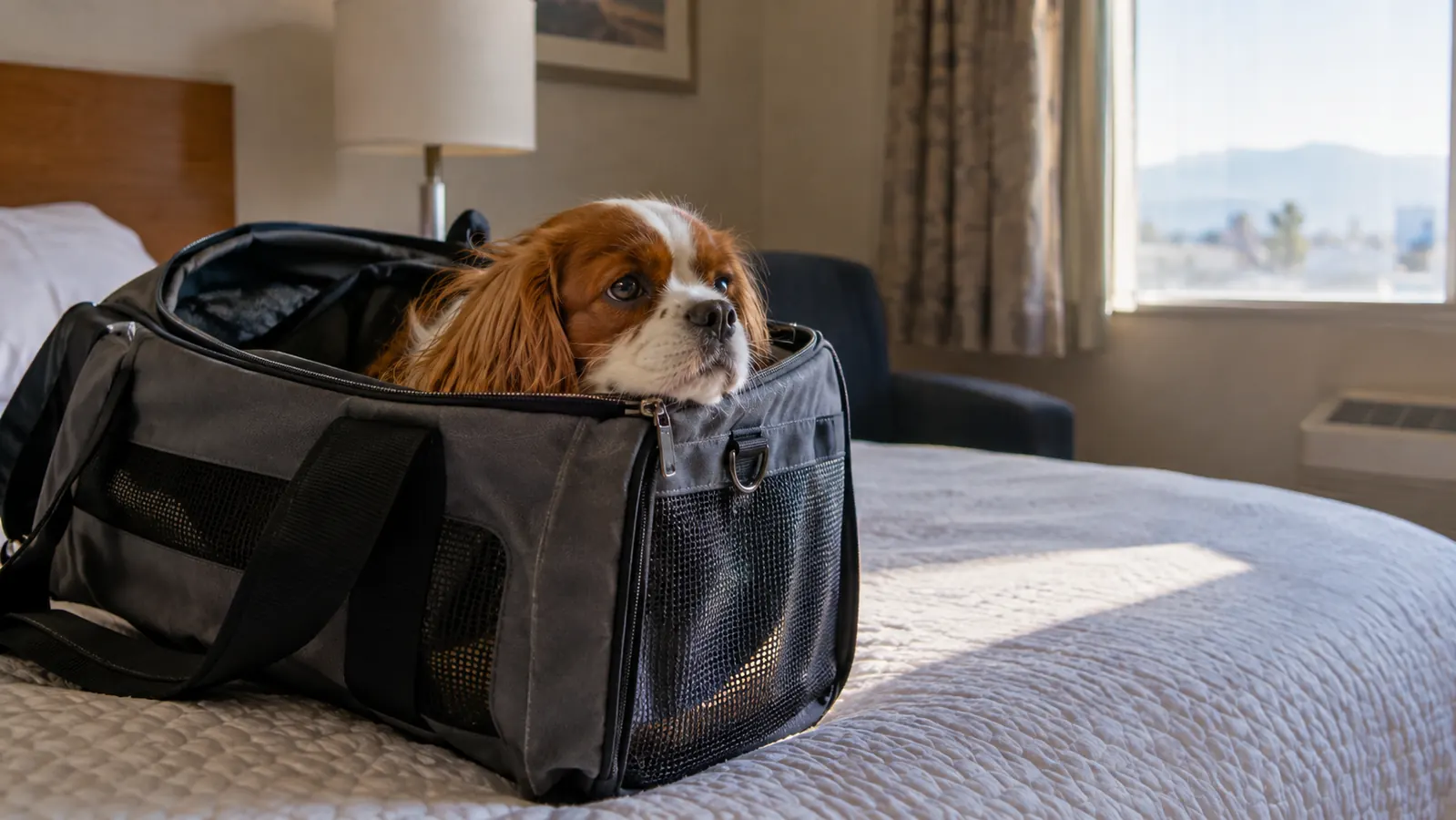
I still remember the phone call from my sister Joan. She had adopted Pip, a 10-pound Shih Tzu, a few months earlier, and the two of them were planning to join Ron and me for a long weekend in the Blue Ridge Mountains. Pip had never been more than twenty minutes from Joan's house in Charlotte. The trip would be three hours each way, plus rest stops, plus a motel room that was not home. Joan asked me the question every dog owner asks at some point: how do you get a dog comfortable in a travel carrier?
I have tested a lot of carriers over the years, and the one I keep recommending for small dogs is the Sherpa Original Deluxe Travel Pet Carrier. It is soft sided, which makes it easier for a nervous dog to curl up in, and it has a sturdy frame that keeps the top from collapsing on the dog's head. But the carrier is only half the battle. The other half is the training, and that is what this article is about.
Start With a Carrier Your Dog Can Love
The Sherpa Original Deluxe Travel Pet Carrier is the one I recommend for dogs under 16-18 pounds. It is soft sided, airline approved, and built to hold up through years of road trips. Check today's price on Amazon and have it at your door in two days.
Amazon Check Today's Price on Amazon →The mistake most people make is buying the carrier, zipping the dog inside, and driving off. The dog spends the whole ride panting, pacing, or crying. Then the owner decides the dog hates the carrier. The carrier is not the problem. The dog was never given a reason to like it. The fix is a slow, patient process that takes about two weeks if you do it every day, and less if your dog is already relaxed about new things.
This order works because it gives your dog a story about the carrier. First the carrier is a boring piece of furniture. Then it is a place where food appears. Then it is a place where the door closes but nothing bad happens. Then it is a place that travels in the car. Only after all of that is it a place that goes on a real trip. Each step builds on the one before, and each step is something your dog chooses to do.
Step 1: Make the Carrier a Piece of Furniture
The first step is to take the carrier out of its box and put it somewhere your dog already spends time. For Joan, that meant the corner of the living room where Pip liked to nap. Leave the top flap open and the front door rolled back and secured. Do not put the dog inside yet. Do not even call the dog over to the carrier. Just let the carrier exist in the room. Most dogs are curious about a new object for about a day, and then it becomes background noise.
The Sherpa carrier has a soft, washable liner, which is nice because it will start to smell like the house after a few days. That smell is a signal to your dog that this thing is safe. You can speed things up by rubbing your hands over the liner and then over the floor of the carrier, or by placing a small blanket your dog already sleeps on inside. The goal of step one is simple: the carrier should stop being interesting.
One thing I like about the Sherpa is that the top and sides are soft, so it does not have the hard, closed-in feel of a plastic crate. A nervous dog can press against the sides and feel them give a little. Pip would nose the side of the carrier like she was checking that it was real, and then settle down.
Step 2: Feed Meals Near the Carrier
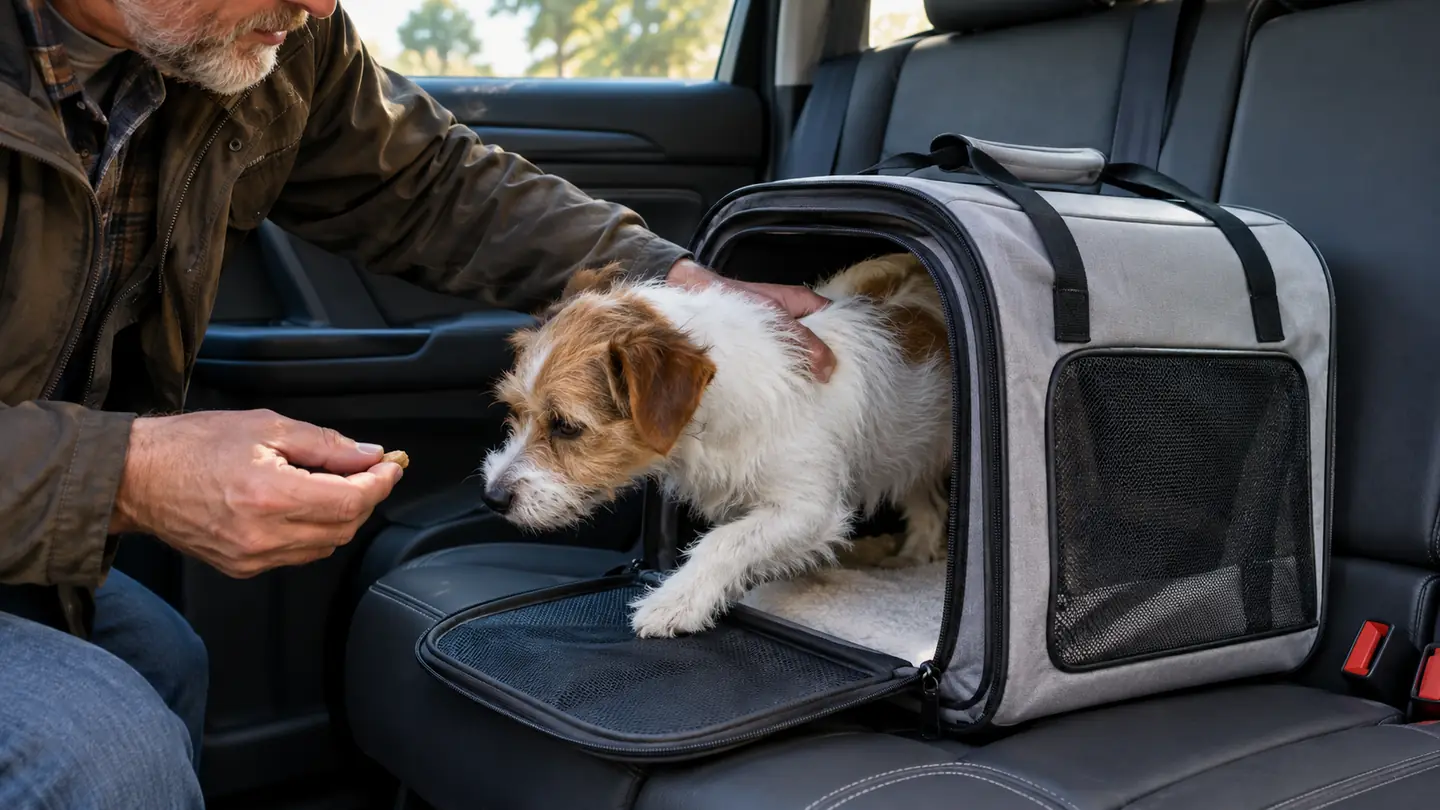
Start by putting the food bowl a few feet from the open carrier. Each day, move it a little closer. Once your dog is eating with the bowl right at the entrance, put the bowl just inside the door. That moment is a big one. Do not close the door. Let your dog step in, eat, and step out. The carrier becomes a place where good things happen, not a trap.
With the Sherpa, the opening is wide enough for a small dog to step in and out without ducking, which helps a hesitant dog feel brave. Pip started by stretching her neck in, grabbing a single kibble, and backing out. Within three days she was walking all the way in and sitting down to eat. If your dog will not eat inside, go back to feeding at the entrance for another day or two. There is no prize for rushing.
Step 3: Short, Door-Open Hangs
Once your dog walks in and out of the carrier on its own, start closing the door for a few seconds while your dog is inside eating a treat. Then open it again. Do this several times a day, gradually working up to a minute, then five minutes. The goal is for your dog to look at the closed door and think 'fine, I will just lie here.' You are teaching the dog that being inside with the door closed is not the same as being trapped.
Some dogs panic the first time the door closes. If that happens, go back to feeding with the door open and spend a few more days on step two. You can also practice closing the door while your dog is busy with a long-lasting chew. The chew keeps the mouth busy, which seems to help the brain stay calm. Pip did best when Joan gave her a small treat, closed the door, and then sat on the floor next to the carrier reading a book. Just sitting nearby matters.
A good sign is when your dog chooses the carrier on its own. Sometime during the second week, Pip walked into the Sherpa, turned around twice, and lay down with her chin on the rim. Joan nearly cried. That is the moment the training worked. From there, the car was easy.
Step 4: Practice Car Rides Without Going Anywhere
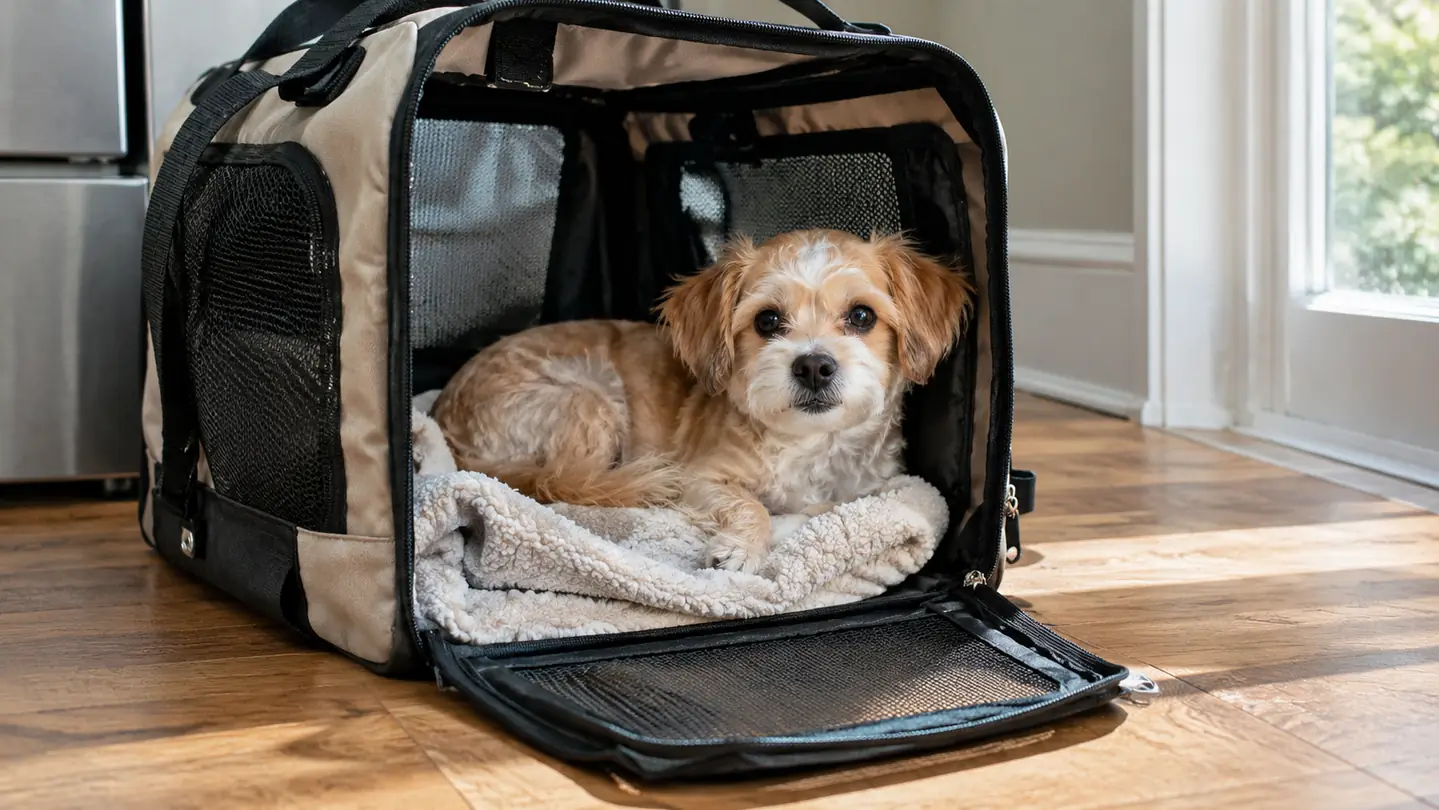
The car is a different environment from the living room, and dogs know the difference. So take the carrier out to the car and put it in the back seat, buckled in with the seat belt. Let your dog explore it in the car while the engine is off. Then turn the engine on and sit there for a few minutes. Then take a very short drive around the block. Do not go anywhere exciting. The point is to teach your dog that the carrier in the car is boring and safe.
Joan was surprised by how much this step helped. Pip had always been restless in the car, standing on the seat, looking out the window, whining at trucks. The first time she rode in the Sherpa, she lay down within a few minutes. The soft sides seemed to help. Instead of sliding around on the seat, she had a stable little cave of her own. By the third short drive, Pip was asleep before they got to the end of Joan's street.
Keep the first few drives under ten minutes. A drive that ends at home is a good drive. If your dog gets queasy, keep the carrier on the floor or the seat where it is most stable, and do not feed a big meal right before. You want the association to be calm and uneventful. Save the fun destinations for later. A note on the seat belt: the Sherpa has a loop on the back that a seat belt passes through. Use it. A carrier that slides around on the seat is more likely to make a dog feel unsteady, and a dog that feels unsteady is harder to settle. Buckling the carrier in is a five-second step that removes a whole category of problems.
Step 5: Take the Real Trip
By the time the Blue Ridge weekend came, Pip had spent about ten days working through steps one through four. Joan put the Sherpa in the back seat of her car, buckled it in, and lined it with one of Pip's blankets. She dropped a few treats inside and let Pip climb in on her own. The first hour was quiet. At the rest stop, Pip stayed in the carrier with the door open while Joan stood nearby. The trip home was even easier.
The motel room was the part I was most curious about. A carrier is not just for the car. Joan brought the Sherpa inside and set it on the floor next to the bed. Pip used it as a den. When the room felt too strange, Pip walked into the carrier and lay down. That one behavior is worth the entire training process. A dog who has a safe spot in a new place is a dog who can relax on a trip.
One more note about the motel. Do not unpack everything. Leave the carrier out and available the whole trip. Dogs read a room by smell, and the carrier smells like home. When Pip felt overwhelmed, she walked into the carrier instead of hiding under the bed. That is exactly what you want from a travel carrier.
What Else Helps
A few extras made the difference for Pip. A worn t-shirt from Joan, folded flat under the liner, gave the carrier a familiar scent. A small chew that Pip only got in the carrier kept her busy for the first twenty minutes of each drive. And the seat belt loop, which the Sherpa has built in, meant the carrier did not slide around when Joan turned corners. None of these are expensive, and all of them make the carrier feel more like home.
I would also say this: the Sherpa is a small-dog carrier. It is right for dogs roughly under 16-18 pounds. My own dog Maple is a 45-pound Australian Shepherd mix and she is far too big for it, so she rides in the back seat of our Outback with a seat belt harness. For Pip, though, the Sherpa is exactly right. If you have a small dog who travels with you, this is the process I would use to get them comfortable in a travel carrier.
Even if you never fly with your dog, the airline approval is a useful sign. It means the zippers are strong, the seams are reinforced, and the whole thing is built to a standard that inspectors actually check. For a car trip, that kind of construction means the carrier will hold up when your dog steps on it, leans against it, and uses it as a bed for years.
If your dog is still nervous after two weeks, slow down. Go back to step two and spend a few more days there. Some dogs take a month. That is fine. The carrier is not a test. It is a tool, and the only schedule that matters is your dog's.
The carrier was never the problem. The problem was that Pip had never been given a reason to like it. Once she had, she slept through most of the drive.
Help Your Small Dog Feel at Home on the Road
The Sherpa Original Deluxe Travel Pet Carrier is soft sided, airline approved, and made for dogs under 16-18 pounds. If you have a small dog who travels with you, this is the carrier I would start with. Check today's price on Amazon and see the current options.
Amazon Check Today's Price on Amazon →